How aquafeed formulation software is changing the nutritionist workflow
Aquafeed nutrition used to move in relatively fixed cycles: update raw-material costs, adjust nutrient specs, run least-cost options, then hand a formula to the mill. Today, formulation is more continuous. Ingredient markets shift faster, alternative proteins need tighter validation, and extrusion performance must be considered before a ration reaches production.
Modern formulation software is becoming the shared operating layer for nutrition, procurement, quality, and manufacturing. For aquafeed teams, that changes the role of the nutritionist from recipe builder to systems decision-maker.
For enzyme strategy, this matters. A formulation platform can only create value when the biological assumptions behind an enzyme matrix are practical, validated, and compatible with plant-scale feed production.
Pelletide works as an enzyme supplier for aquafeed manufacturing teams that need formulation-ready support: clear application logic, raw-material flexibility, and dependable supply for mills producing fish and shrimp feeds.
From static formulation to live decision workflow
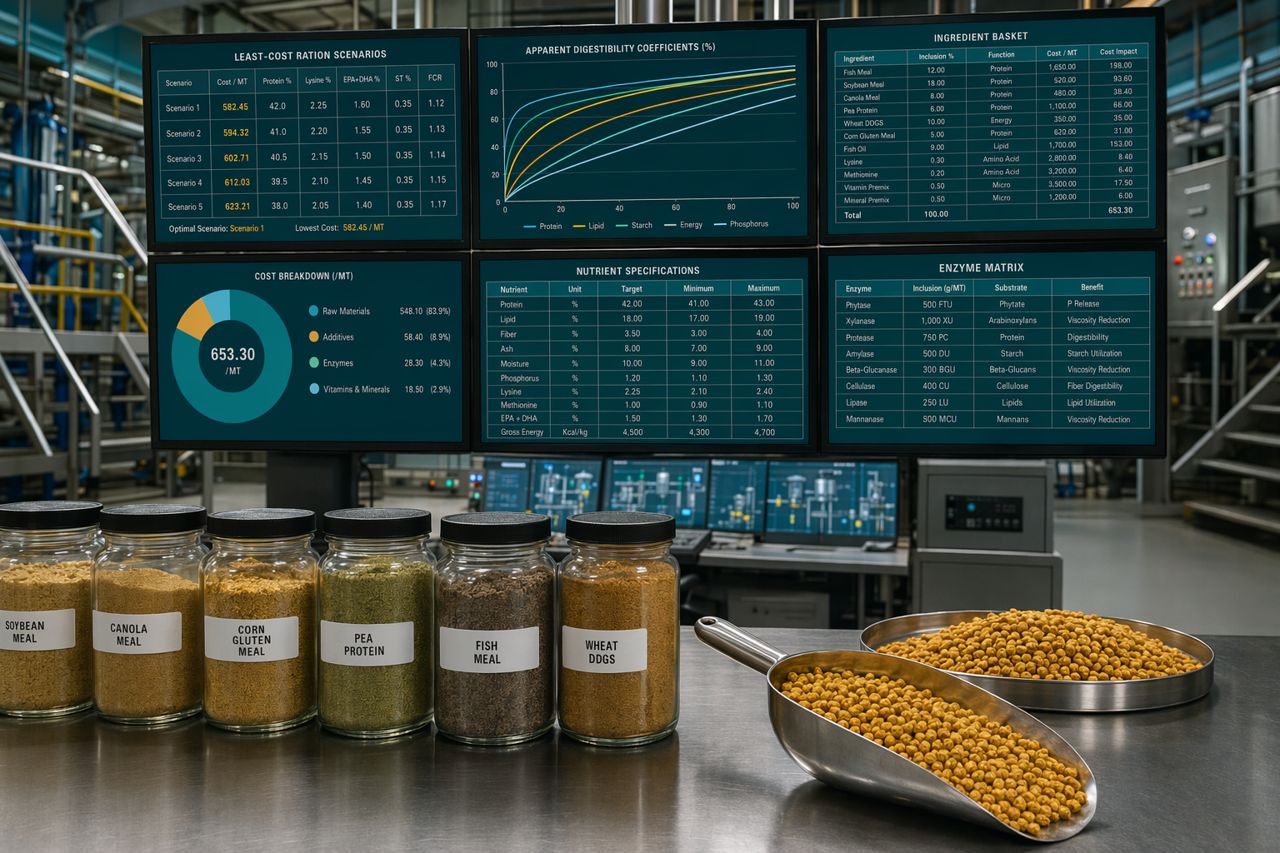
Software has expanded beyond basic least-cost calculation. In a modern aquafeed mill, the formulation environment may connect:
- Raw-material pricing and availability
- Species and life-stage nutrient specifications
- Digestible nutrient assumptions
- Alternative protein inclusion limits
- Pellet durability and water stability targets
- Extrusion, drying, coating, and liquid application constraints
- Supplier documentation and internal approval rules
- Trial feedback from farm or tank performance
This changes the nutritionist workflow. Instead of asking only, “What is the lowest-cost formula today?” the better question becomes:
Which formula gives the best performance confidence under current raw-material, processing, and supply conditions?
That question is where enzymes become strategic rather than additive.
Why enzyme matrices need formulation discipline
An enzyme matrix is a formulation assumption. It tells the software what nutrient contribution, substrate effect, or raw-material flexibility can be credited when an enzyme is included.
If the matrix is too conservative, the feed may leave value unused. If it is too aggressive, ration performance or pellet consistency can suffer. The right approach is species-aware, ingredient-aware, and process-aware.
Aquafeed teams typically evaluate enzyme use across several practical objectives:
- Improving nutrient release from plant-based raw materials
- Supporting higher use of alternative proteins
- Reducing dependence on volatile premium ingredients
- Helping maintain ration performance as ingredient quality varies
- Supporting digestibility targets without over-formulating
- Building more flexible least-cost scenarios for procurement
The software does not replace nutritional judgement. It makes assumptions visible, testable, and easier to govern.
The nutritionist’s workflow is becoming more cross-functional
Formulation decisions now touch more departments than ever.
Procurement sees scenario value
When nutritionists can model multiple ingredient baskets, procurement gains better visibility into substitution options. Enzymes can support this by widening the usable range of plant proteins, oilseed meals, cereal fractions, and by-products where appropriate.
The commercial benefit is not only lower formula cost. It is improved resilience when a preferred raw material becomes expensive, inconsistent, or unavailable.
Quality teams need clearer specifications
As ingredient variability increases, quality teams need practical acceptance rules. Software can help align supplier data, incoming raw-material checks, and formulation limits.
For enzyme use, the key is consistency: clear product identity, storage guidance, compatibility expectations, and documentation that supports internal approval.
Mill teams need manufacturable formulas
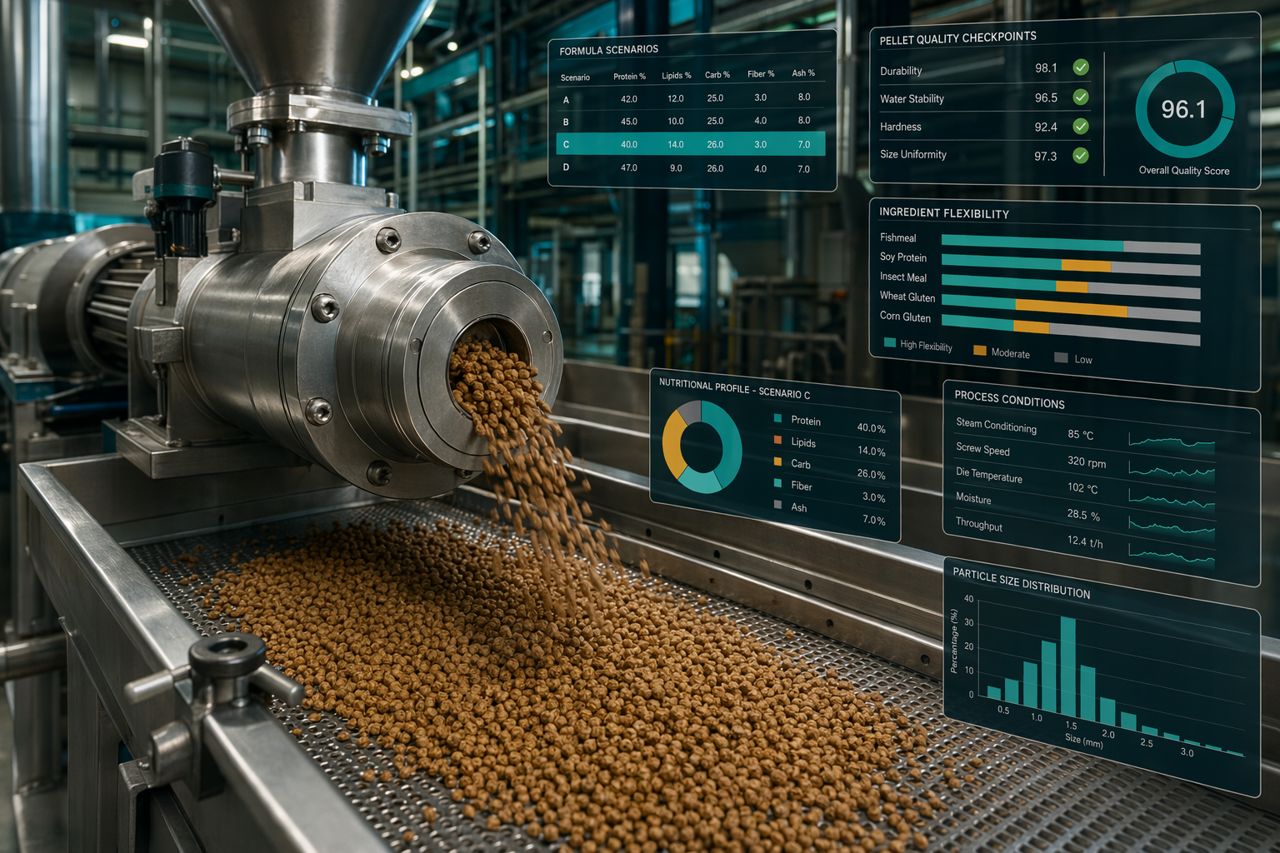
A formula that looks efficient in software must still run through grinding, mixing, extrusion, drying, coating, and packing. Nutritionists increasingly need to consider pellet density, fat coating strategy, fines, water stability, and thermal exposure.
Enzyme decisions should be made with the manufacturing route in mind. This includes whether the enzyme is intended for pre-extrusion inclusion, post-process application, or another mill-specific handling approach.
What software changes in enzyme evaluation
Formulation software improves enzyme decision-making in four ways.
1. Faster scenario comparison
Nutritionists can compare enzyme-included and enzyme-free scenarios across multiple raw-material baskets. This helps reveal where the enzyme creates the most value: cost control, nutrient release, ingredient flexibility, or performance protection.
2. Better control of formulation assumptions
Matrix values can be reviewed, locked, adjusted, and approved within a controlled workflow. This reduces the risk of informal spreadsheet logic being copied into production without review.
3. Stronger link between trials and formulas
When trial outcomes are captured and linked back to formulation assumptions, nutrition teams can refine how they credit enzyme contribution across species, stages, and ingredient profiles.
4. Cleaner commercial conversations
Software makes it easier to discuss enzyme value in buyer-relevant terms: formula space, raw-material substitution, procurement options, performance confidence, and manufacturability.
Data quality matters more than software features
The best formulation platform cannot compensate for weak input data. Aquafeed teams should treat enzyme-related assumptions as controlled nutritional data, not generic additive notes.
Useful enzyme-support data should help answer:
- Which substrates or ingredient classes are relevant?
- Which species and life stages are the best fit?
- What formulation credit is appropriate for the intended use case?
- How should the enzyme be handled in the mill?
- What compatibility factors need to be considered?
- How should results be reviewed after production or feeding trials?
Pelletide supports customers with practical enzyme guidance designed for formulation and production teams, not just procurement catalogues.
The new workflow: from model to mill
A practical aquafeed formulation workflow may look like this:
- Define the nutritional target by species, stage, feed type, and performance objective.
- Review the ingredient basket for cost, availability, substrate profile, and quality risk.
- Model enzyme-supported scenarios using controlled matrix assumptions.
- Check mill feasibility against extrusion route, coating plan, pellet quality requirements, and handling conditions.
- Compare commercial outcomes across cost, flexibility, and expected performance confidence.
- Run production and feeding validation where needed.
- Refine the model with practical results and approved internal rules.
This loop turns formulation software into a decision system. Enzymes become part of a documented strategy rather than a late-stage inclusion.
What aquafeed buyers should expect from an enzyme partner
As formulation becomes more software-led, mills need enzyme suppliers that can work with nutrition, procurement, QA, and production stakeholders.
A strong B2B enzyme partner should provide:
- Formulation-ready product positioning
- Practical matrix support for defined feed strategies
- Clear species and ingredient fit
- Compatibility thinking for aquafeed processing
- Documentation for purchasing and quality approval
- Reliable industrial supply planning
- Technical support that respects the nutritionist’s model
For aquafeed mills, the value is not simply buying an enzyme. The value is making enzyme use easier to justify, model, approve, produce, and repeat.
Pelletide perspective
The next generation of aquafeed formulation will be more dynamic, more data-led, and more connected to manufacturing reality. Nutritionists will still make the critical calls, but software will make those calls faster to test and easier to defend.
Pelletide supports this shift with enzyme solutions for aquafeed teams that need raw-material flexibility, ration performance confidence, and dependable plant-scale supply.
If your formulation workflow is moving toward more alternative proteins, tighter digestibility models, or more flexible procurement scenarios, Pelletide can help you evaluate where enzyme strategy fits.
Request a quote
Ready to discuss an enzyme solution for your aquafeed formulation workflow? Use the on-site request a quote form and share your species focus, feed type, ingredient priorities, and mill process. Pelletide will review the fit and respond with a practical B2B supply pathway.