Digestibility Enhancers for Aquafeed: Matching Protease, Carbohydrase and Phytase to the Diet
Feed is 60-70% of the cost of producing fish and shrimp, and rising protein ingredient prices squeeze the margin from the other side. In a plant-protein shrimp diet about 80% of the feed nitrogen is never absorbed; it leaves the animal and ends up in the water. A digestibility enhancer is the enzyme or enzyme blend that lets the animal use more of the protein, starch, fibre and phosphorus the mill already paid for. This guide shows how to match the enzyme to the diet, the species and the process, with the doses and conditions behind each number, so you can brief a supplier properly instead of buying a generic "feed enzyme". Feed manufacturers, premixers and distributors can request a wholesale quote at any point.
Wholesale and bulk supply for manufacturers and resellers, quoted per order. To get a quote, send the product or enzyme type, the quantity and the destination country through the quote form.
Start from the ingredient basket, not the enzyme name
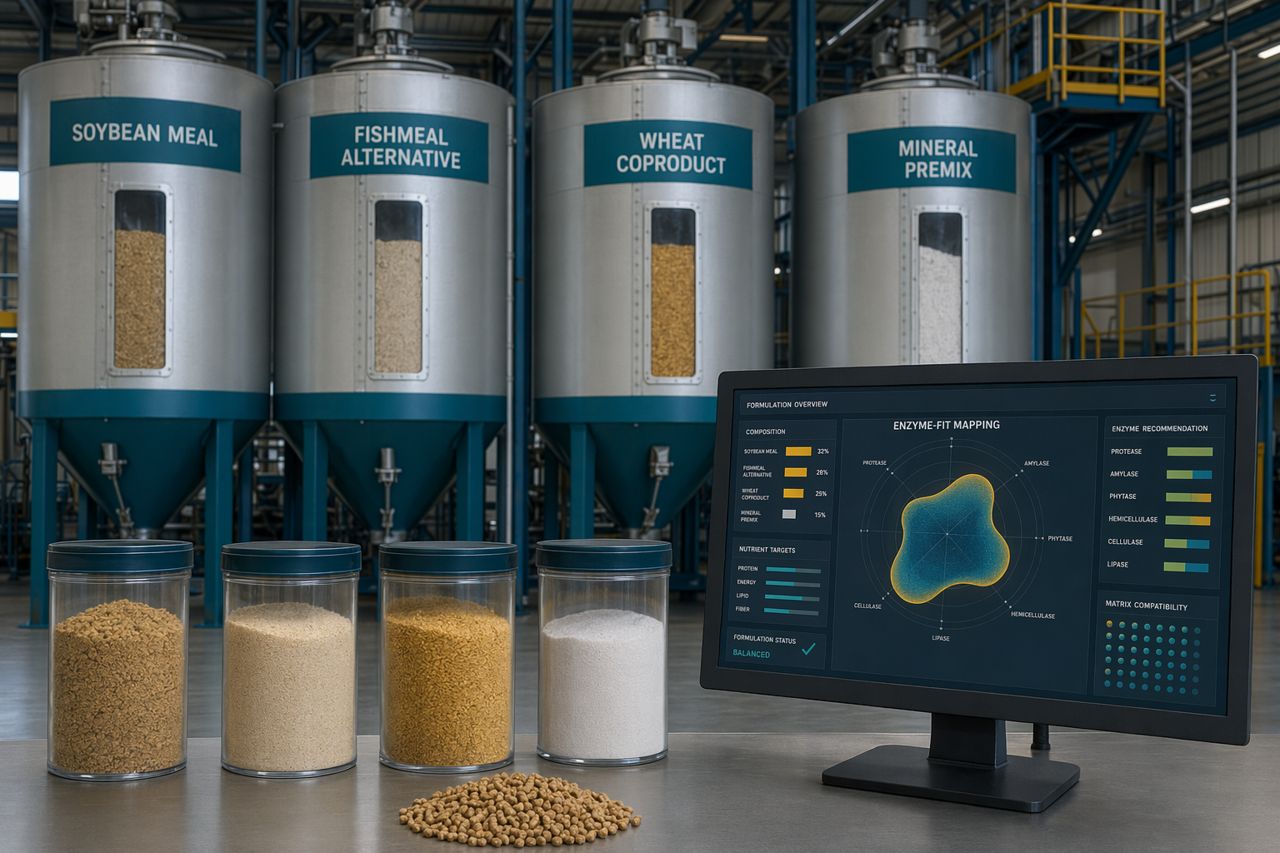
Pick the enzyme by feed type first: corn-soy, high-protein, high-starch, high-fibre and high-fat diets each call for a different lead enzyme, and the animal's age and species decide the rest. Reduced-soy policies and lower phosphate supplementation are pushing mills toward plant material they could ignore before, which is where the digestibility gap opens. Soy protein concentrate is far cheaper than fish meal and is being developed as a direct fish-meal replacement, so the protein side of the basket is changing fastest. In pond catfish, a 30% protein diet built on cottonseed meal, corn gluten feed or DDGS gives optimum growth and feed efficiency, fed once a day to near satiation at about 140 pounds per acre per day with roughly 7,000 fish per acre. Those are exactly the by-product proteins where a protease and a fibre-degrading carbohydrase earn their place.
Wheat-heavy diets have their own enzyme logic. A liquid xylanase preparation made for cereal flour and wheat starch carries a fungal endo-xylanase with minor cellulase and beta-glucanase side activities, works across pH 4.5-7.0 and 20-65 C, is dosed at 50-150 ml per tonne and keeps for 12 months. A wheat-diet complex enzyme is also sold as its own product line for livestock and poultry feed, which tells you the wheat basket is a recognised sub-case rather than something a corn-soy blend covers by accident. For the starch side, a mid-temperature alpha-amylase at 3000 U/g is offered as a solid digestive feed additive. A straight xylanase (CAS 9001-62-1) comes in 1 kg packs, convenient for a trial batch before you commit to drums.
Insect meal is the newest ingredient problem. Black soldier fly meal often arrives incompletely hydrolysed, with large protein molecules left intact, and that drags down digestibility in fish and shrimp; a protease formulated to hydrolyse insect protein is now sold to aquafeed mills for that reason.
Match the lead enzyme to the species
Species lines usually split like this: a high-activity protease for shrimp, a lipase-led blend for fish, and a gentle blend for sea cucumber. Shrimp have a short digestive tract and secrete few enzymes of their own, so their packs lead with protease and add amylase and lipase, formulated separately for larvae, transition and high-density stages. Shrimp products need heat-resistant and acid-resistant encapsulation, and they are either dosed during feed production or mixed fresh on the farm. Fish lines are asked for low-temperature performance and a water-stable formulation, and the better suppliers keep separate lines for fish, shrimp, crab and sea cucumber. For sea cucumber the weak points are juveniles and heat-stress periods, when limited endogenous enzymes mean more ammonia nitrogen in the water; the usual blend is protease plus amylase plus lipase. The mechanism is the same in every species: juveniles and stressed animals secrete too little enzyme, undigested nitrogen and phosphorus pollute the water, and a heat-stable blend of protease, amylase, phytase, cellulase and pectinase applied after extrusion cuts effluent phosphorus.
Comparison table: enzyme, trigger, dose seen, process risk, what to ask
| Enzyme | Diet trigger | Dose and result seen in a trial or spec | Process note | What to ask a supplier |
|---|---|---|---|---|
| Protease (shrimp) | Plant protein replacing fish meal | 100-300 mg/kg feed (30,000-90,000 NFP units/kg); FCR 1.41 to 1.30-1.31; protein digestibility 75.4% to 77.7-78.8% over 62 days on a 34.4% protein diet | Vacuum-coated for thermal stability | Activity unit used, coating type, retained activity after your extruder |
| Phytase (fish) | Plant ingredients, phytate-bound phosphorus and minerals | 500-2,400 U/kg feed; calcium utilisation +130%, total phosphorus +104-122%, phytate phosphorus +74-89% | Thermal stability reported as not limiting from room temperature to 100 C | Units per gram, phosphorus credit you may take in the matrix |
| Multi-enzyme (protease, lipase, amylase) plus phytase | Freshwater shrimp and specialty fish | 0.1% blend plus 1,000 IU/kg phytase; weight gain +12.13%, feed coefficient -12.02%, digestibility +4.81% | Promotional case study, best case up to 48% weight gain in giant freshwater prawn | The baseline diet and whether the trial was controlled |
| Protease:lipase:cellulase 2:1:3 | Tilapia on mixed plant diets | FCR 1.6 to 1.3, described as a 20% feed saving; no per-kg dose stated | Ratio only, so not a dose you can order against | The inclusion rate in g per tonne behind the ratio |
| Liquid xylanase (with minor cellulase and beta-glucanase) | Wheat, wheat middlings, cereal flour | 50-150 ml per tonne; pH 4.5-7.0; 20-65 C; 12 months shelf life | Liquid, so post-extrusion spraying is natural | Side activities on the spec sheet, storage temperature |
| Mid-temperature alpha-amylase | Starch-heavy or high-cereal diets | 3000 U/g solid | Solid, so it rides through conditioning unless coated | Temperature optimum and whether "mid-temperature" survives your conditioner |
Buyers rarely stop at one enzyme. Phytase is usually bought together with acid or neutral protease, xylanase and alpha-amylase, a protease plus carbohydrase plus phytase stack in practice, and protease is the enzyme aquafeed buyers most often reach for first.
Heat is where most aquafeed enzyme programmes fail
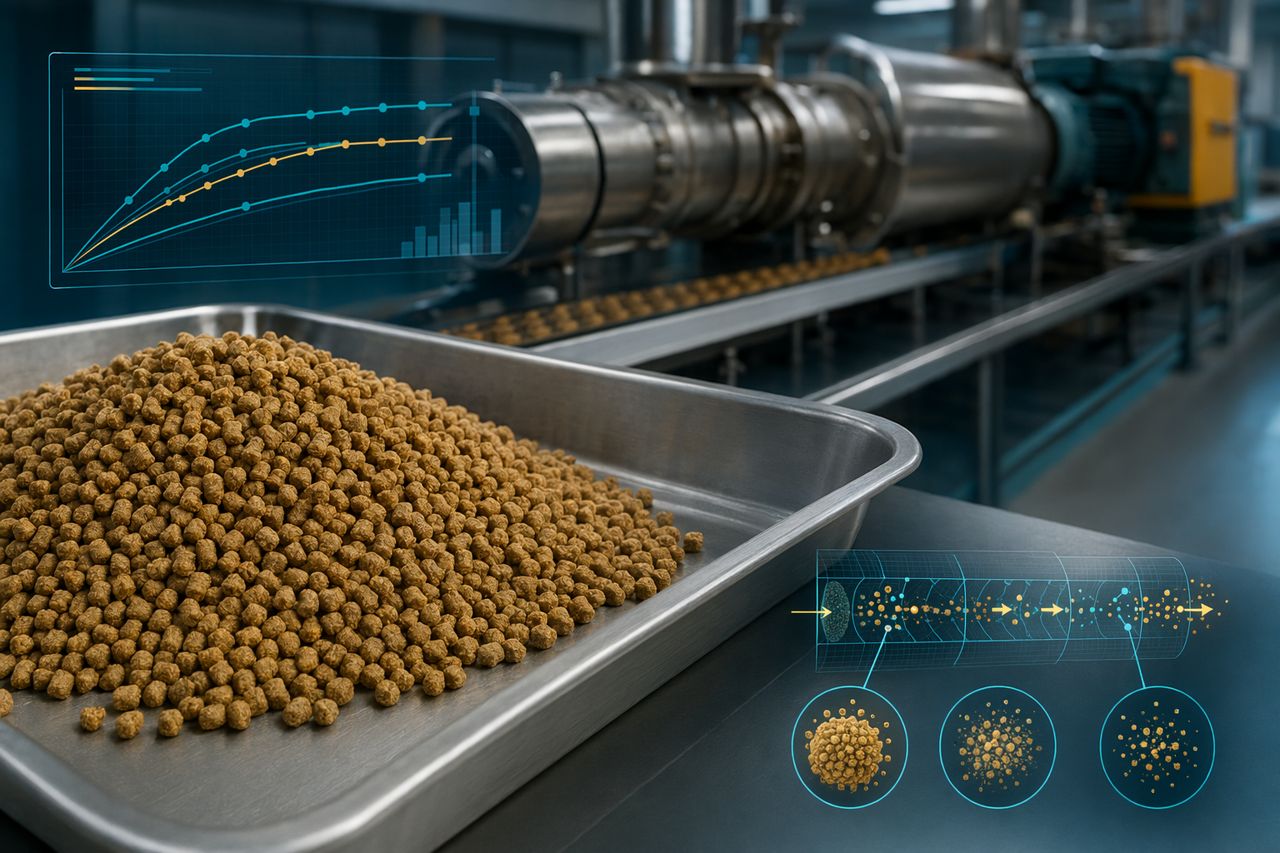
Standard enzymes lose over 50% of their activity when pellets are made at 80-95 C. Conditioning above 80 C and extrusion at 100-150 C can inactivate an enzyme outright, while the enzymes themselves work best at 30-60 C and the water in many ponds sits below 30 C. Pellet lines run above 90 C, and the on-farm answer is to mix the enzyme onto the finished pellet and wait at least 2 hours before feeding so it activates. A post-pellet coating kit pairing protease and phytase exists for exactly that step. Coated and protected composite kits of protease, amylase, cellulase and xylanase are sprayed onto shrimp feed after processing to keep the activity and improve water quality. When the feed's enzymes are heat-damaged and nothing replaces them, intensive shrimp and crab farms report slow feeding, intestinal inflammation and white feces. Demand for custom heat-stable blends with technical support is now explicit from both food and feed buyers, so you can ask for one rather than accepting a general-purpose grade.
Converting activity units into grams per tonne
Under a video on phosphorus equivalency of phytases, three separate viewers asked the same thing; one wrote, "What is the weight in grams of the standard dose of 500FTU, 1,000FTU and 1,500 FTU?" The question has no answer until you know the activity of the product itself. Divide the target dose per kg of feed by the product's units per gram to get grams per kg, then multiply by 1,000 for grams per tonne; a 500 FTU/kg target from a product assayed at 5,000 FTU/g is 0.1 g per kg, or 100 g per tonne, and the same arithmetic applies to protease and xylanase units. Always ask the supplier for the assay method behind the unit, because two products quoting the same number under different methods are not interchangeable.
Six mistakes we see in enzyme programmes
- A heat-sensitive formula in a hot pelleted feed: the four common errors are the wrong enzyme type, a single enzyme instead of a blend, a formula that loses activity in pelleting, and a mismatched species.
- Expecting growth promotion from a protease: the 62-day shrimp trial was explicit that the gain was efficiency and lower ammonia nitrogen, not growth.
- Quoting a best case as a planning number: the prawn weight-gain range of 12.95% to 48% is the ceiling of a promotional study, not what your pond will do.
- Applying a farm slurry rate at the mill: an insect-enzyme slurry is mixed at 10-20% of feed for seedlings and 5-10% at mid-stage, with pond sprays of 1-5 kg per acre, and those inclusion rates have nothing to do with a mill-grade concentrate.
- Mixing up units: FTU or U/g of product versus grams per tonne of feed, as in the viewer questions above.
- Ignoring the carbohydrase side of a wheat or by-product diet: groundnut cake, for example, runs 45-60% protein but also 22-30% carbohydrate and 3.8-7.5% crude fibre, and a protease alone leaves that fraction untouched.
In-mill dosing or on-farm top-dressing?
For a farm mixing its own feed, the realistic route is a coated or liquid grade applied after the pellet is cooled, with the 2-hour activation wait before feeding. For a mill, the choice is between a heat-stable encapsulated grade dosed before extrusion and a post-extrusion liquid application.
What to ask a supplier before you order
- Activity and unit: the units per gram or per ml, the assay method, and the activity retained after your actual conditioning and extrusion temperature.
- Grade and form: solid or liquid, coated or encapsulated, and whether the grade is sold as a species line for fish, shrimp, crab or sea cucumber.
- Pack sizes: a 1 kg trial pack before you commit to drums, so the plant trial runs on your own basket.
- Companion products: feed-additive suppliers increasingly pair phytase with Bacillus spores for phosphorus efficacy and gut health, with customised packaging for export customers.
- Probiotic synergy: species blends are often sold alongside Bacillus, Clostridium butyricum and Enterococcus faecium packages.
- What the mill wants on paper: anti-nutritional factor breakdown, protein hydrolysis efficiency and energy from fibre, with protease plus cellulase plus lipase plus phytase kits sold per species.
- Thermal data for phytase specifically: the fish-feed source reports stability as not limiting up to 100 C, and you should ask for the same curve on the grade you are quoted.
Send us your diet and get a shortlist
Email us your species, stage, top five ingredients and extrusion or pelleting temperature, and we reply with a dosing worksheet, an enzyme shortlist and a sample plan for your plant trial. Use the request form on this page and paste the diet details into the message field.