Aquafeed Sustainability Metrics From the Feed Mill Perspective
For an aquafeed mill, sustainability is not a slogan. It is a set of operating metrics that show up in formulation cost, pellet durability, nutrient release, water quality, and feed conversion at the farm.
Nutritionists and feed mill teams are under pressure to use raw materials more efficiently while maintaining predictable ration performance. Marine meals and oils remain valuable, but availability, price volatility, and sourcing expectations continue to push the industry toward broader ingredient baskets. That shift makes digestibility, anti-nutritional factors, pellet water stability, and gut-level nutrient access more important than ever.
Pelletide supports aquafeed manufacturers with enzyme solutions designed for this practical reality: more flexible formulations, more efficient nutrient use, and dependable plant-scale supply. If you are evaluating an enzyme supplier for aquafeed manufacturing, the right discussion should connect enzyme selection with mill economics, species nutrition, ingredient variability, and measurable sustainability outcomes.
The feed mill sustainability scorecard
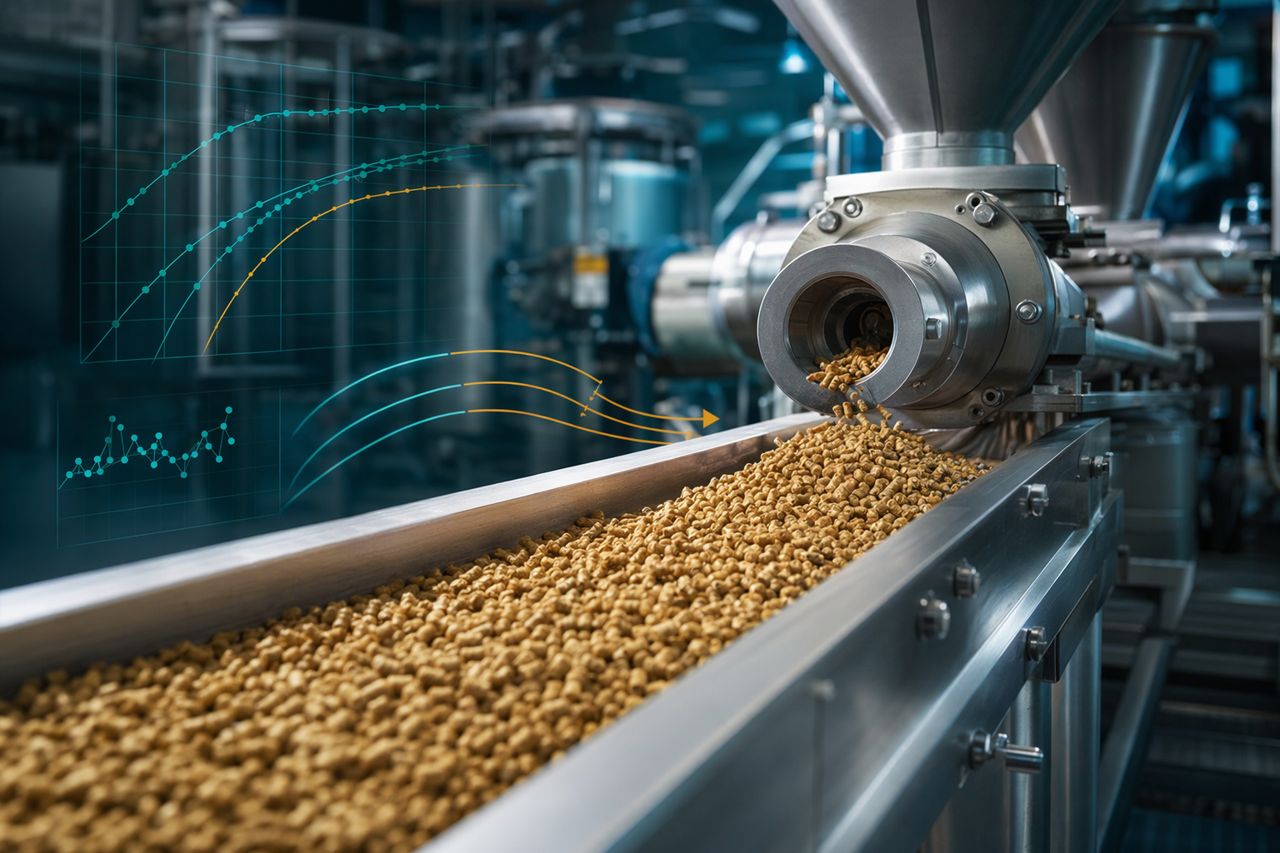
Aquafeed sustainability is often discussed at the ingredient or farm level. The feed mill connects both. It converts ingredient choices into finished pellets that must perform through production, transport, storage, feeding, and digestion.
A practical feed mill scorecard includes:
- Nutrient efficiency: how much of the ration is converted into animal growth rather than lost in feces, fines, or uneaten feed.
- FCR contribution: how formulation, digestibility, and pellet quality support lower feed input per unit of biomass.
- Raw-material flexibility: the mill's ability to use plant proteins, co-products, and alternative ingredients without compromising performance.
- Pellet integrity: durability, water stability, and low fines through handling and feeding systems.
- Waste reduction: less undigested phosphorus, nitrogen, and organic load entering the culture environment.
- Supply resilience: consistent enzyme availability, documentation, and technical support across production planning cycles.
Enzymes are not a substitute for sound formulation. They are formulation tools that can unlock value when matched to substrate, species, process conditions, and commercial targets.
Nutrient efficiency is the first sustainability metric
The most sustainable tonne of feed is the tonne that delivers more available nutrition to the fish or shrimp. That makes digestibility central to feed mill sustainability.
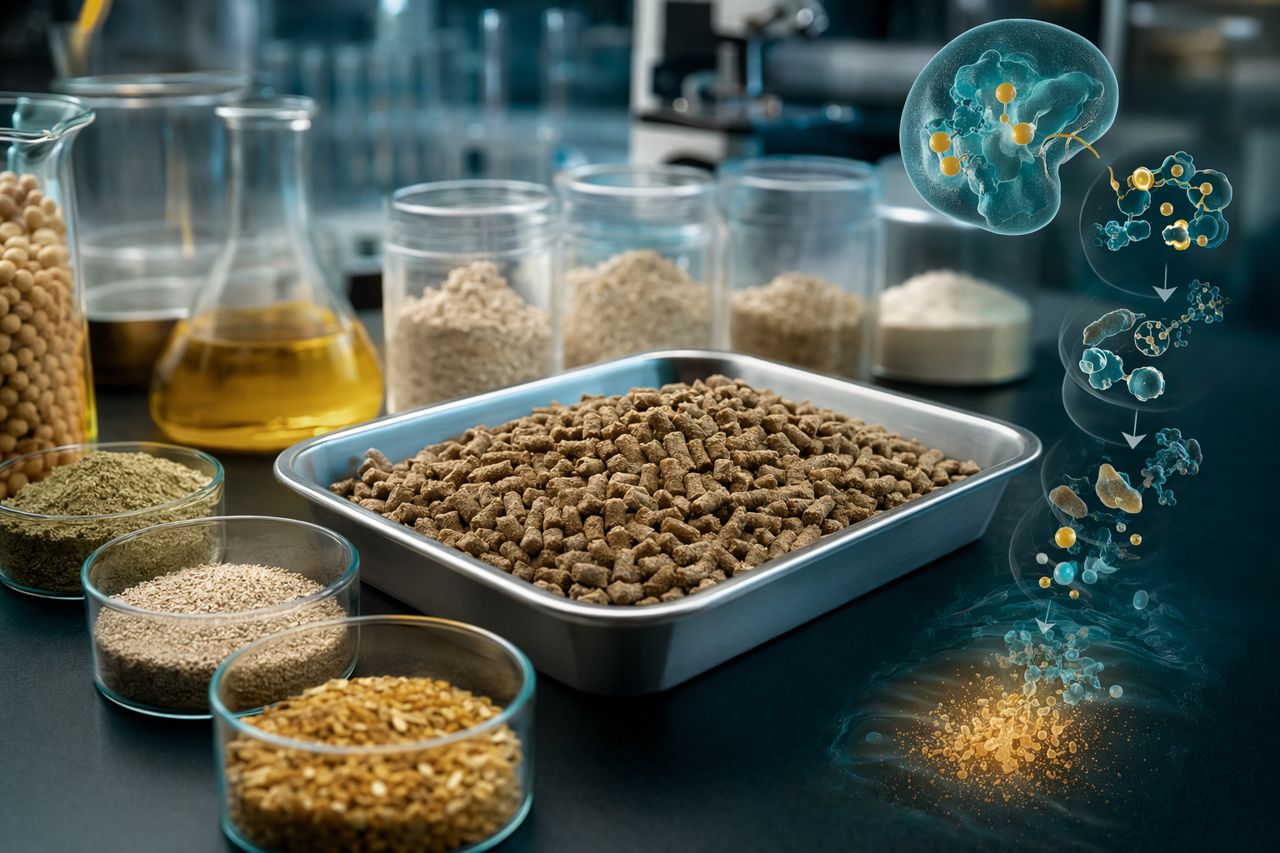
In aquafeed, nutritionists often manage complex matrices: starch sources for extrusion performance, plant proteins with fiber and phytate fractions, animal by-products with variable digestibility, and lipid systems designed for energy density. Enzymes can support this matrix by helping release nutrients that are otherwise partially unavailable.
Key enzyme-enabled routes include:
- Improved phosphorus availability from phytate-containing plant ingredients.
- Better protein access where protease solutions are aligned with formulation goals.
- Reduced viscosity or improved carbohydrate utilization in diets containing non-starch polysaccharides.
- More consistent digestible nutrient contribution from variable plant meals and co-products.
For feed mills, the value is not only biological. Better nutrient release can influence safety margins, reformulation options, mineral strategies, and total ration economics.
Ingredient sourcing: flexibility without losing control
Ingredient sustainability often depends on local availability, marine resource pressure, land-use considerations, transport distance, and price stability. Feed mills need room to move without creating performance risk.
Enzymes help nutritionists evaluate a wider set of ingredients by targeting known constraints:
- Phytate-bound minerals in plant meals.
- Fiber-linked nutrient encapsulation.
- Protein fractions with variable digestibility.
- Carbohydrate structures that influence gut viscosity and nutrient access.
This does not mean every alternative ingredient becomes equal. It means the nutrition team has more tools to manage digestibility gaps and formulate with clearer intent.
A good enzyme program should be evaluated alongside:
- Species and life stage.
- Ingredient inclusion rates.
- Extrusion and drying conditions.
- Pellet size and feeding behavior.
- Expected nutrient release and matrix values.
- Farm-level FCR and water quality observations.
Pellet quality is part of sustainability
Sustainability metrics can fail before the feed reaches the animal. Fines, breakage, poor water stability, or inconsistent pellet structure can increase waste and reduce feeding efficiency.
Aquafeed mills must balance digestibility with physical quality. Extrusion variables, starch functionality, fat coating, particle size, steam conditioning, drying, and cooling all influence pellet performance. Enzyme selection should be compatible with these realities.
For buyers, the question is not simply whether an enzyme works in theory. The question is whether it fits the feed mill's process window and supports a finished product that holds together under real handling and feeding conditions.
A supplier conversation should cover:
- Where the enzyme is applied in the process.
- Expected stability through relevant production steps.
- Compatibility with premix handling and liquid application systems.
- Impact on formulation assumptions and pellet specifications.
- Documentation needed for internal quality teams and customer assurance.
Waste reduction: the environmental signal farms can see
Undigested nutrients do not disappear. They can contribute to fecal output, phosphorus discharge, nitrogen load, and organic accumulation around farming systems.
From a mill perspective, reducing waste starts with making the ration more available. When nutrients are released and absorbed more efficiently, less feed input is needed to support growth, and less nutrient load is wasted into water.
The strongest sustainability story is built from linked evidence:
- Formulation change at the mill.
- Improved digestibility or nutrient availability expectation.
- Maintained or improved pellet quality.
- Farm-level FCR movement.
- Reduced nutrient waste indicators where measured.
- More resilient ingredient sourcing strategy.
That chain is more useful to B2B buyers than broad claims because it connects procurement, nutrition, manufacturing, and customer outcomes.
FCR remains the commercial bridge
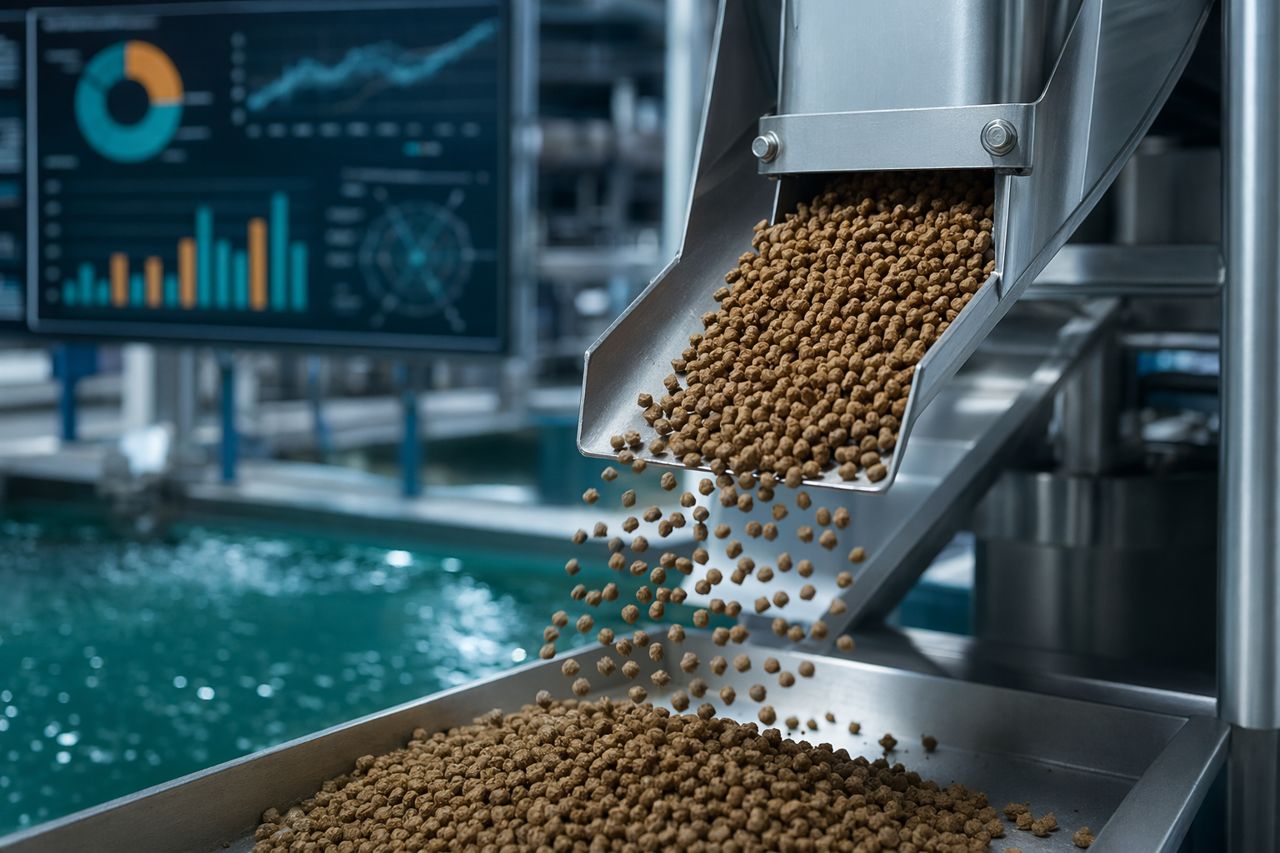
Feed conversion ratio is where sustainability and economics meet. Lower FCR can reduce feed volume per production cycle, reduce logistics intensity, and improve farm profitability. It can also reduce nutrient output per unit of harvested biomass.
Enzymes can support FCR by helping the animal access more nutrition from the same ration or by allowing a reformulated ration to maintain performance. The result depends on species, diet composition, management conditions, and the baseline quality of the formulation.
For feed mills, the important decision is how enzyme value is captured:
- As a performance support in premium diets.
- As a reformulation lever in cost-sensitive diets.
- As a raw-material flexibility tool.
- As a mineral strategy component.
- As a sustainability documentation point for downstream customers.
The best answer may be different across shrimp, salmonids, tilapia, marine fish, and warm-water species programs.
What to ask an enzyme supplier
A credible enzyme supplier for aquafeed manufacturing should be able to discuss more than product names. The conversation should be technical, commercial, and plant-aware.
Ask for clarity on:
Formulation fit
- Which substrates the enzyme is intended to target.
- How it should be positioned in plant-based or mixed-protein diets.
- What matrix assumptions are appropriate for your nutrition strategy.
- How it interacts with mineral, amino acid, and energy specifications.
Manufacturing fit
- Recommended addition point.
- Handling format and dosing practicality.
- Compatibility with extrusion, drying, coating, and premix workflows.
- Storage and logistics requirements for production planning.
Commercial fit
- Expected value drivers by species and diet type.
- Support for trials and internal validation.
- Supply continuity and batch-to-batch documentation.
- Technical response time when raw materials or process conditions change.
A mill-level approach to sustainability metrics
For many aquafeed producers, the strongest sustainability framework is operational rather than abstract. It can be built around questions the mill already tracks:
- Can we maintain growth performance with a more flexible ingredient basket?
- Can we reduce excess mineral input while preserving animal nutrition?
- Can pellet quality remain stable when formulation changes?
- Can we reduce nutrient waste without adding complexity to production?
- Can we document the value clearly for farm customers and brand owners?
Enzyme programs fit well when they help answer those questions with data, process discipline, and dependable supply.
How Pelletide supports aquafeed mills
Pelletide works with aquafeed buyers who need enzyme solutions aligned with real formulation and manufacturing constraints. Our focus is practical: support ration performance, improve nutrient access, enable ingredient flexibility, and help mills build a clearer sustainability case from the feed outward.
We help procurement, nutrition, and production teams evaluate enzyme options against:
- Target species and growth stage.
- Ingredient strategy and substrate profile.
- Pellet format and manufacturing route.
- Reformulation goals and economic targets.
- Documentation needs for technical and customer-facing teams.
Request a quote
If your team is reviewing enzyme options for aquafeed sustainability, nutrient efficiency, or raw-material flexibility, Pelletide can help you map the technical fit and supply requirements.